
Locksmith Licensing: The Harm Reduction vs. Harm Elimination Debate
Why Smart People Look at the Same Evidence and Reach Opposite Conclusions

Locksmith Licensing: The Harm Reduction vs. Harm Elimination Debate
Why Smart People Look at the Same Evidence and Reach Opposite Conclusions
The Core Issue
Does locksmith licensing protect consumers and honest businesses, or is it just bureaucratic revenue with barriers to entry?
After 30+ years operating across licensed and unlicensed states, serving on Louisiana’s licensing board, and working with ALOA, law enforcement (including FBI and organized crime divisions), Google, and NASTF, I’ve watched smart, honest people look at identical evidence and reach completely opposite conclusions.
The reason: They’re applying different frameworks for what “success” means.
The Framework Question
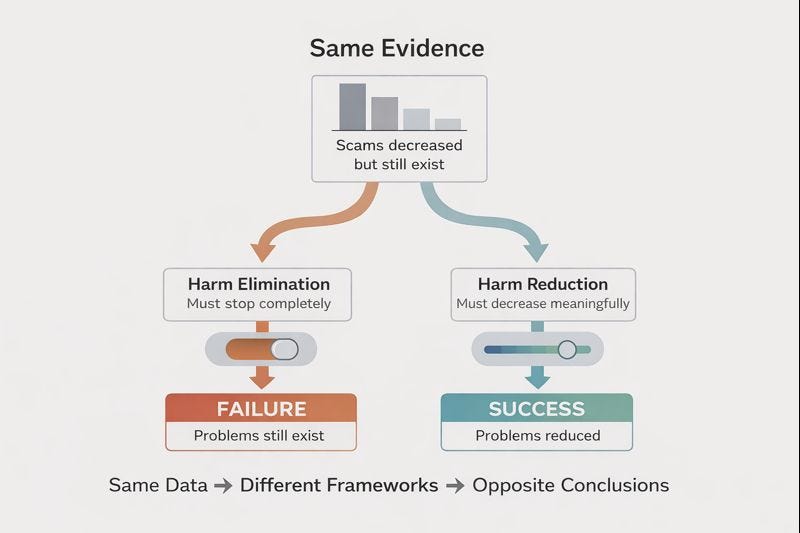
Imagine a state implements locksmith licensing with background checks, testing, and enforcement. Three years later, unlicensed operations have decreased, consumer complaints are down, but scams still happen and legitimate operators face compliance costs.
Did it work?
Person A says no. Scams still exist. Consumers still get ripped off. Money spent on bureaucracy didn’t solve the problem. Failure.
Person B says yes. Fewer scams than before. Fewer unlicensed operators. Consumers have recourse. Measurable improvement. Success.
Same evidence. Opposite conclusions.
Person A applies a harm elimination framework: Does it stop the problem completely?
Person B applies a harm reduction framework: Does it meaningfully decrease the problem?
Neither framework is objectively wrong—they’re different standards for success. But your framework choice determines everything else in this debate.
Test your consistency: Apply this to traffic laws, food safety, or building codes. Do you demand zero violations for success, or accept reduced risks? If you accept harm reduction in those domains, why apply a different standard to locksmith licensing?
The Current Landscape
As of December 2025, only 13 states require locksmith licensing: Alabama, California, Connecticut, Illinois (sunsetting 2029), Louisiana, Maryland, Nevada, New Jersey, North Carolina, Oklahoma, Oregon, Texas, and Virginia.[1][2] The other 37 have no statewide requirement, though some have county or city rules.
This patchwork creates legitimate frustration. A locksmith licensed in Texas faces different requirements in Oklahoma, none in Arkansas, and Tennessee just repealed theirs in 2021. Someone operating across state lines navigates an inconsistent maze—or gets fined for violations they didn’t know existed.
The first interpretation question: Does geographic inconsistency prove the system is arbitrary (eliminate it), or does it reflect state experimentation that needs coordination (reform it)?
Your answer likely depends on whether you view federalism as feature or bug.
The Common Arguments
Both sides cite real observations:
Critics argue: Licensing is revenue generation with weak enforcement, burdens honest operators while scammers evade it, fails to prevent bait-and-switch pricing, and creates anti-competitive barriers through provisions like competitor sponsorship requirements.
Supporters argue: It’s vital for public safety through background checks, creates traceability for investigations, enables platform verification (Google requires licenses where they exist), and needs reform rather than elimination.
Voluntary certification advocates see market-driven alternatives through reviews and professional associations.
Here’s what matters: No position is irrational. Each stems from direct observation. The divide is about frameworks. Elimination thinkers see persistence of problems as failure. Reduction thinkers see fewer problems as progress.
Every single claim in this debate flips based on which framework you apply.
How Claims Flip Based on Framework
“Scams still happen in licensed states”
Elimination view: Total failure. Problem exists. Resources wasted.
Reduction view: Expected. Question is: Are there fewer than before? Than in unlicensed states?
“Good locksmiths thrive without licensing”
Elimination view: Proves licensing unnecessary.
Reduction view: Doesn’t address whether licensing reduces bad actors overall.
“Licensing is expensive and burdensome”
Elimination view: Unless it eliminates harm, burden isn’t justified.
Reduction view: Cost-benefit question—how much harm reduction per dollar spent?
“Enforcement is inconsistent across states”
Elimination view: Proves the system is arbitrary. Eliminate it.
Reduction view: Proves implementation quality matters. Fix enforcement funding.
This pattern repeats across every major argument. The framework you choose predicts your conclusion better than any specific piece of evidence.
What Licensing Actually Does
Typical systems across the 13 states include background checks, fingerprinting, identity verification, testing (varies), and scope definitions for different work types. This creates verifiable databases, enforcement mechanisms through regulatory violations, and verification gates for platforms like Google.
Costs run from hundreds to thousands annually in application fees, renewals, testing, and administrative time.
What licensing directly targets: Unlicensed operations, credential impersonation, and criminal history screening.
What it indirectly affects: Spam operations (raises costs), anonymous bad actors (creates traceability), and consumer recourse (complaint pathways).
What it doesn’t address: Consensual pricing practices (legally protected), quality of work (licensing isn’t skill certification), or all fraud (enforcement is imperfect).
What it economically creates: Barriers to entry, which standard microeconomic theory shows affect market pricing and employment across licensed professions.[18][19]
Should licensing be judged against what it targets, or what critics wish it addressed?
The Pricing Problem: Legal Limits
Here’s where many critics focus: bait-and-switch pricing. Advertise $19, arrive and quote $250, customer agrees under urgency, work gets done. It’s legal under the doctrine of caveat emptor (”buyer beware”) if the customer consented to the final price, even under pressure.
Licensing boards can act on unlicensed operation, credential fraud, or provable material misrepresentation. They generally cannot act on “I thought it would be cheaper” or “The price was too high” or “I felt pressured but agreed.”
Should licensing be judged a failure for not solving problems it legally cannot address?
The elimination framework says: If it doesn’t stop the most complained-about harm, it’s worthless.
The reduction framework says: It addresses the harms within its legal authority—identity verification, background screening, recourse for threats and fraud.
From actual consumer testimony: “I called a locksmith and someone showed up in a van with a duct-taped logo and no ID. Said he didn’t need a license. I just want someone I can trust, you know? Licensing might not be perfect, but at least it’s something.” Later: “After paying three times what I was quoted, I left a negative review—then got threats demanding I take it down.”[AKS]
Licensing addressed the identity issue and provides recourse for the threats. It couldn’t address the pricing. If it solved one of three problems, is that success or failure?
Google’s 2025 Potential Game-Changer—If Enforceable
In September 2025, Google updated its Misrepresentation policy with explicit language: “Price exploitation in vulnerable situations—example: a locksmith threatening to leave the customer unless a cost above what was quoted is paid on the spot.”[13][14][15]
Effective October 28, 2025, Google now requires clear upfront fee disclosure and bans bait-and-switch tactics in its platform.
State licensing cannot do this due to caveat emptor protections in consumer law. Google can because it’s a private platform setting terms of service.
The Enforcement Question
How does Google verify compliance? Scammers could simply add “and up” or “starting at” language to their ads and listings. “$19 and up” technically discloses variable pricing while preserving the bait tactic. Does Google’s policy close this loophole, or does it create compliance theater where bad actors learn the magic words to avoid detection?
The detection problem: Google relies on consumer complaints and algorithmic patterns to identify violations. Scammers who’ve operated for years understand how to stay just below detection thresholds—rotating business names, creating new listings faster than removals, spreading complaints across multiple entities.
The scale problem: Google has removed millions of fake listings and sued major networks,[8][9] yet new ones appear constantly. The company documented review extortion schemes where attackers flood business profiles with fake negative reviews, then demand payment (often $5,000+) to remove them—contacting victims through third-party apps like WhatsApp to evade monitoring.[24] Google created a reporting form for these extortion attempts in November 2025,[25] but the policy is only as effective as enforcement resources and detection capabilities.
Elimination interpretation: Policy without consistent enforcement is window dressing. Scammers will adapt faster than platforms can update rules.
Reduction interpretation: Even imperfect enforcement raises costs for bad actors, provides consumer recourse, and enables legal action against large networks.
The Insider Corruption Vulnerability: A Theoretical Attack Surface
Legal Disclaimer: The following section presents a theoretical vulnerability analysis based on economic incentives and opportunity structures. We are not aware of specific evidence that this form of corruption is occurring, nor are we alleging that it is. This is a risk assessment of potential exploitation vectors, not a claim of actual wrongdoing.
Here’s a vulnerability that neither licensing nor platform policies may adequately address: What happens if bad actors infiltrate the enforcement system itself?
The Economic Logic
Consider the attack surface from a purely theoretical standpoint:
Google’s global workforce for trust and safety, listing review, and complaint processing includes thousands of contractors across multiple countries. These positions often exist in regions where annual salaries might range from $6,000-$15,000 USD.
The economics: A scam network generating hundreds of thousands monthly could theoretically afford to pay a contractor $500-$1,000 per month—potentially doubling their income—in exchange for favorable administrative decisions.
What Such Corruption Might Accomplish
If it were to occur, an insider with access to trust and safety systems could theoretically:
Approve listing reinstatements after removal
Suppress or remove negative reviews
Bypass verification requirements
Provide advance warning of enforcement actions
Manipulate competitor listings
Why Detection Would Be Difficult
Communication outside monitoring: WhatsApp, Telegram, or other encrypted messaging apps allow coordination entirely outside platform networks. International money transfer apps enable payment without creating internal audit trails.
Legitimate cover: Unlike overt hacking, this appears as normal administrative decisions. How does a platform distinguish between a contractor making a judgment call versus being paid to make favorable decisions? The forensic footprint is minimal when communication and payment occur off-platform.
Scale economics: For large scam operations (millions in annual revenue), investing $50,000-$100,000 to compromise 5-10 key contractors across different regions represents a tiny percentage of revenue with potentially massive impact on enforcement effectiveness.
Why We’re Raising This
We have no evidence this is occurring. Searches of news reports, court records, and industry coverage revealed no documented cases of Google contractors being bribed to manipulate locksmith listings or reviews.
We raise it because:
The economic incentive clearly exists. Scam networks have both motive (millions in revenue to protect) and means (modest cost relative to revenue).
The opportunity structure exists. Global contractor workforces with access to enforcement systems are documented facts of platform operations.
Detection difficulty is high. Off-platform communication and payment create minimal forensic evidence.
It affects the core policy question. If platform enforcement can be compromised through insider corruption, what does that mean for the “platforms can handle it” versus “licensing provides independent verification” debate?
Counterarguments
Platforms have internal controls. Large technology companies invest heavily in:
Contractor screening and background checks
Behavioral anomaly detection for unusual decision patterns
Audit processes for high-stakes actions
Multiple layers of review for significant decisions
Anti-corruption training and monitoring
We don’t know these controls’ effectiveness against sophisticated, patient actors who understand the monitoring systems.
How This Affects the Framework Debate
Elimination interpretation: If both licensing (enforcement gaps, regulatory capture) and platforms (potential insider corruption, enforcement loopholes) are vulnerable, then multiple flawed systems don’t create one functional system—they create expensive, redundant failure.
Reduction interpretation: Licensing provides background checks, identity verification, and state legal authority. Platforms control visibility and pricing practices. A sophisticated bad actor might compromise one system but faces difficulty compromising all simultaneously. Multiple independent enforcement mechanisms create redundancy against single-point corruption.
The honest assessment: We don’t know the extent of this theoretical vulnerability. We know the economic incentive exists, the opportunity exists through global contractor networks, and detection would be technically difficult. Whether it occurs at scale is unknown. But it represents a genuine weakness in any enforcement model that relies on human intermediaries with access to override systems.
The Irony of Multiple Enforcement Mechanisms
The elimination framework says: Licensing has enforcement gaps and regulatory capture risks. Platforms have loopholes and potential insider corruption. Neither is perfect—so why pay for both? Multiple flawed systems don’t create one functional system; they create expensive redundancy.
The reduction framework says: No single enforcement mechanism is perfect. Licensing provides background checks and legal authority. Platforms control visibility and pricing practices. Neither alone is sufficient, but together they create multiple barriers. A scammer might bypass one system but faces difficulty bypassing all simultaneously.
Are these competing alternatives or complementary systems? Evidence suggests complementary—Google explicitly requires license verification where it exists, and unlicensed states show weaker platform verification gates. But both systems have exploitable vulnerabilities that sophisticated bad actors will find.
Enforcement: Where Outcomes Diverge
A statute without investigators is expensive paperwork. As one locksmith put it: “What good are safety measures if the government doesn’t enforce them? What’s the point of having locks on doors if you don’t actually lock them?”[AKS]
When enforcement is resourced—Louisiana’s Office of State Fire Marshal with dedicated investigators is one example—states show noticeable reductions in unlicensed operations, large-scale spam networks, and impersonation complaints. The magnitude isn’t formally measured, but the difference is observable.
Many states don’t use Google’s law enforcement reporting system (LERS), which enables qualified agencies to submit evidence for rapid listing and ad removal.
Is the problem the concept or the execution? That depends on your framework. Elimination thinkers see poor execution as proof the concept is flawed. Reduction thinkers see it as proof funding matters more than statutes.
The Interstate Chaos
No/Little reciprocity exists between the 13 states. From actual forums: “I’ve been rekeying homes since dial-up internet. I’ve never had a complaint or a Yelp review below four stars. But I got fined $275 for ‘unauthorized locksmith activity’ in a state I was just passing through. Didn’t even stop for lunch.”[AKS]
Elimination view: This injustice proves the system is arbitrary and should be eliminated.
Reduction view: This injustice proves interstate coordination (like nursing compacts in 38 states) is needed.
When you see broken implementation, do you conclude the concept is flawed or execution is flawed?
Tennessee’s Natural Experiment
Tennessee repealed licensing in 2021. Observed correlation (not proof of causation): Platforms adjusted verification requirements to be less stringent, observers noted increases in fake listings in metro areas, and lead-generation spam operations became more prevalent.[17]
We don’t have comprehensive consumer harm data, so interpretation splits along framework lines.
Elimination: Even if scams increased, doesn’t prove licensing would have prevented them.
Reduction: Observable increase suggests licensing created meaningful friction.
The Anti-Competitive Problem
Some state systems include provisions that protect incumbents rather than consumers: mandatory competitor sponsorship (existing licensees must approve newcomers), forced employment requirements (work for licensed locksmith X years before applying), vague “good moral character” clauses with no clear standards, and excessive fees beyond enforcement costs.
Important context: No law or regulation is legally enacted to reduce competition. When licensing serves primarily to restrict market entry rather than address public safety concerns, it becomes vulnerable to antitrust challenges.[20][21] Defenders of licensing should focus exclusively on public safety justifications (background checks for security work, identity verification for accountability) rather than competitive benefits, which undermine legal standing.
Economic research shows occupational licensing does create barriers to entry, affecting market pricing and employment.[18][19] The question isn’t whether these effects exist—they do—but whether safety benefits justify the costs.
Can you separate consumer protection from anti-competitive provisions? Defensible requirements exist: criminal background checks, identity verification, basic competency testing, transparent processes, reasonable fees.
Elimination view: Any anti-competitive provision disqualifies the entire concept.
Reduction view: Strip anti-competitive provisions while keeping consumer-protective elements.
How Scams Operate
The predatory model uses thousands of fake Google listings with local phone numbers, centralized call centers, low bait prices, and urgency exploitation. On-site: unmarked vehicles, no ID, price increases to $250-$500+, and pressure tactics. Aftermath: threats over negative reviews, business name changes, new listings appear, cycle repeats.
Google has removed millions of fake listings and sued networks.[8][9] FTC issued multiple alerts about fake locksmiths particularly in unlicensed states. A 2017 NBC LA investigation found 50%+ of “local locksmiths” in online directories were fake or unlicensed. Better Business Bureau reports scam complaints more commonly in states without licensing.[AKS]
Elimination interpretation: Scams exist everywhere, proving licensing doesn’t work.
Reduction interpretation: Scams concentrate in unlicensed states, suggesting licensing creates friction.
How would you test which is correct?
What Evidence Actually Supports
With confidence, we know:
Licensing creates verification mechanisms, background check gatekeeping, regulatory enforcement pathways, traceability for investigations, and compliance costs (hundreds to thousands annually).
Licensing creates economic effects: barriers to entry, which affect market pricing and employment—consistent with research on occupational licensing.[18][19]
Licensing does not eliminate scams, prevent all unlicensed operation, regulate consensual pricing, guarantee quality, or create consistency across the 13 different state systems.
Observable correlations (not proof): Scam warnings concentrate in unlicensed states, fake listings more prevalent in unlicensed states, Tennessee repeal correlated with increased spam.
Anti-competitive provisions exist in some states: competitor sponsorship, forced employment, excessive fees.
Without confidence, we cannot say:
The magnitude of harm reduction (no comprehensive controlled studies measuring scam rates, consumer harm, or complaint resolution). No formal cost-benefit analysis comparing safety benefits to economic costs. No systematic comparison of well-funded versus poorly-funded enforcement. No rigorous testing of alternatives like platform-only enforcement or voluntary certification.
The honest answer: Suggestive evidence exists through correlations, observations, and platform behavior, but not definitive proof of magnitude.
If you require elimination, licensing fails—problems persist. If you accept reduction, licensing may succeed if evidence suggests meaningful decrease, but we lack rigorous measurement.
What Would Reform Look Like?
If keeping licensing: Eliminate anti-competitive provisions (competitor sponsorship, forced employment, vague character clauses), fund actual enforcement with dedicated investigators and digital capabilities, create interstate coordination through compacts or reciprocity agreements, and measure outcomes systematically with published annual reports.
If eliminating licensing: What replaces it? Platform verification only (what happens when policies change?), voluntary certification (what percentage would participate?), market mechanisms only (does this work for emergency one-time services?), or enhanced consumer protection laws (how is this different from current system?).
The Final Question
This article presented evidence of what licensing does and doesn’t do, multiple interpretations of the same facts, questions to reveal your framework, and options for both reform and elimination.
If you conclude licensing fails because scams still exist, problems aren’t completely eliminated, or any anti-competitive provision disqualifies the concept—you’re applying a harm elimination framework.
If you conclude licensing succeeds or could succeed because observable reductions occur, verification mechanisms provide value, or anti-competitive provisions can be reformed—you’re applying a harm reduction framework.
Neither framework is objectively wrong. But your framework choice determines everything else.
Ask yourself: What evidence would change your mind? For anti-licensing advocates: controlled study showing large reduction? Anti-competitive provisions removed? Interstate reciprocity? Or nothing—philosophical objection? For pro-licensing advocates: controlled study showing no reduction? Proof of regulatory capture? Better alternative demonstrated? Or nothing—safety principle?
Your answer reveals whether you’re open to evidence or committed to framework.
My Conclusion (Not Yours)
After 30+ years across jurisdictions, licensing in well-enforced states appears to noticeably reduce unlicensed operations, large-scale spam networks, and anonymous bad actors—though the magnitude is observable but not rigorously measured.
Licensing creates meaningful tools (background check gatekeeping, faster enforcement than litigation, platform verification gates, consumer complaint pathways) but also creates costs (barriers to entry affecting pricing and employment, anti-competitive provisions in poorly-designed systems, interstate chaos without coordination, expense without enforcement in poorly-funded systems).
My framework is harm reduction—valuable if magnitude justifies costs. My position: current patchwork is suboptimal, well-designed licensing with enforcement provides value, anti-competitive provisions should be eliminated, interstate coordination is essential, and reform beats elimination.
A note on perspective: My position may be unique because of my operational vantage point. I oversee 240+ franchise locations spanning multiple states, which means I must consider the full spectrum: single-person owner-operators working their local market, small shops with a few employees, and multi-location operators navigating interstate complexity. The locksmith industry remains highly fragmented and localized, with most businesses being sole proprietors focused on community-based services.[28] Very few have multiple employees. Even fewer legitimately operate across state lines on a regular basis. This broad operational perspective—balancing the concerns of solo operators against multi-state compliance challenges—may give me a more systems-level view than I would have if I were only representing my own single-shop operation and interests. Someone operating solely in one jurisdiction, with no employees and no interstate considerations, might reasonably reach different conclusions about the value of licensing versus its burdens.
But I’m applying a harm reduction framework and spectrum thinking. Someone applying a harm elimination framework looking at identical evidence reaches the opposite conclusion—and isn’t wrong about their framework preference.
The real debate isn’t about evidence. We lack comprehensive studies. It’s about frameworks. What standard are we applying?
Until we acknowledge this, the debate continues with both sides citing facts that support their predetermined frameworks.
What framework are you applying—and why?
Not: What does the evidence show?
But: What standard are you using to evaluate evidence?
That determines everything.
References
[1] ALOA Legislation – https://www.aloa.org/legislation/aloa-legislation.html
[2] Locksmith Ledger State-by-State (2025) – https://www.locksmithledger.com/home/article/21254499/locksmith-licensing-a-state-by-state-review
[3] Angi: Avoid Locksmith Scams – https://www.angi.com/articles/7-tips-avoid-locksmith-scams.htm
[4] NYT: Fake Online Locksmiths (2016) – https://www.nytimes.com/2016/01/31/business/fake-online-locksmiths-may-be-out-to-pick-your-pocket-too.html
[5] BBB: Don’t Fall for Locksmith Scam – https://www.bbb.org/article/news-releases/22797-bbb-scam-alert-locked-out-dont-fall-for-a-locksmith-scam
[6] CBS: Google Finds 10,000 Fake Listings (2025) – https://www.cbsnews.com/news/google-maps-fake-listings-lawsuit-scams/
[7] NYT: Fake Online Locksmiths (2016) – https://www.nytimes.com/2016/01/31/business/fake-online-locksmiths-may-be-out-to-pick-your-pocket-too.html
[8] USA Today: Google Sues Over Fake Listings (2025) – https://www.usatoday.com/story/money/2025/03/20/google-maps-fake-listings-lawsuit/82572565007/
[9] CNET: Google Sues Scammers (2025) – https://www.cnet.com/tech/services-and-software/google-sues-scammers-behind-thousands-of-fake-business-listings-on-maps/
[10] Louisiana State Fire Marshal – https://sfm.dps.louisiana.gov/lic_burg.htm
[11] Google Ads Verification – https://support.google.com/adspolicy/answer/3038177
[12] Google Business Profile Guidelines – https://support.google.com/business/answer/3038177
[13] Google Dishonest Pricing Policy – https://support.google.com/adspolicy/answer/15938375
[14] Search Engine Land (Sep 2025) – https://searchengineland.com/google-ads-updated-policies-to-target-dishonest-pricing-practices-462555
[15] Search Engine Roundtable (Sep 2025) – https://www.seroundtable.com/google-ads-updates-dishonest-pricing-practices-policy-40158.html
[16] NASTF Requirements – https://support.nastf.org/support/solutions/articles/43000562442-locksmith-license
[17] EliteCEU: Tennessee Repeal – https://www.eliteceu.com/shop/skill-enhancement/tennessee-locksmith-laws-rules/
[18] Kleiner, Morris M., and Alan B. Krueger. “Analyzing the Extent and Influence of Occupational Licensing on the Labor Market.” Journal of Labor Economics 31, no. S1 (2013): S173-S202.
[19] Kleiner, Morris M. Licensing Occupations: Ensuring Quality or Restricting Competition? W.E. Upjohn Institute for Employment Research, 2006.
[20] North Carolina State Board of Dental Examiners v. FTC, 574 U.S. 494 (2015).
[21] Federal Trade Commission and U.S. Department of Justice. “Economic Liberty Task Force: Policy Statement on Self-Regulation and Competition” (2017).
[22] Carroll, Sidney L., and Robert J. Gaston. “Occupational Restrictions and the Quality of Service Received: Some Evidence.” Southern Economic Journal (1981): 959-976.
[23] Johnson, Janna E., and Morris M. Kleiner. “Is Occupational Licensing a Barrier to Interstate Migration?” American Economic Journal: Economic Policy 12, no. 3 (2020): 347-373.
[24] Google. “Fraud and Scams Advisory: November 2025.” Google Safety Blog, November 6, 2025. https://blog.google/technology/safety-security/fraud-and-scams-advisory-november-2025/
[25] Sterling, Greg. “With negative review extortion scams on the rise, use Google’s report form.” Search Engine Land, November 11, 2025. https://searchengineland.com/with-negative-review-extortion-scams-on-the-rise-use-googles-report-form-464515
[AKS] American Key Supply: “The People vs. Locksmith Licensing” by Ryan Barbin – https://substack.com/home/post/p-169489353
[26] AI Assistance Disclosure: This article was developed in collaboration with Claude (Anthropic), representing advanced AI usage as described in Reynolds’ SpeakSynth methodology.[27] The author provided all core arguments, industry expertise, framework analysis, policy positions, and specific examples from 30+ years of operational experience. Claude assisted with structural organization, research synthesis, identification of academic sources, and editorial refinement. Critically, Claude was used to challenge the author’s positions, construct counterarguments, and stress-test reasoning—serving as an intellectual sparring partner to strengthen the analysis and ensure fair representation of opposing viewpoints. All factual claims about the locksmith industry, licensing systems, and enforcement mechanisms originate from the author’s direct knowledge and verified sources. The theoretical vulnerability analysis regarding platform enforcement was conceptualized by the author based on operational risk assessment experience; Claude assisted in framing the legal disclaimers and presenting the analysis with appropriate caveats. The harm reduction vs. harm elimination framework distinction and its application to this policy debate represents the author’s original analytical approach. Claude served as a research and writing assistant, not as a source of domain expertise or policy positions. The ideas, experiences, and conclusions are the author’s; the argumentation and articulation benefited from collaborative AI assistance.
[27] Reynolds, Robert. “SpeakSynth — A Guide to a Humanistic Authorship Workflow.” Empathy-On-Wheels, July 19, 2025. https://empathyonwheels.com/empathy-on-wheels-home/f/a-guide-to-my-human-authorship-workflow-using-voice-to-text
[28] IBISWorld. "Locksmiths in the US - Market Research Report." IBISWorld Industry Reports, 2025. https://www.ibisworld.com/united-states/industry/locksmiths/4833/
About This Analysis: 30+ years in locksmith and security. Former Louisiana licensing board member. Director of Operations for 240+ locations. Collaborated with ALOA, law enforcement (FBI, organized crime divisions), Google, NASTF. Not an attorney. Not claiming objectivity—acknowledging biases from experience with both functional and dysfunctional systems.
Court adjourned. The verdict is yours.
DUN DUN (Great stuff, Ryan, thanks for motivating me to write this piece.)